Architects: Dico si Tiganas – Șerban Țigănaș, Florin Dico, Levente Kornis, Cristian Urcan
Location: Cluj, Romania
Team:
Carmen Brădățeanu , Ciprian Onețiu, Sorin Bularca, Alexandra Bendea,
Ioan Sava, Lorant Miklos, Ioan Bera, Ioan Iov, Iustinian Orza, Teodora
Dănilă, Ciprian Cătineanu, Bogdan Dico, Diana Edițoiu, Cristian Ioja,
Paul Moldovan, Mihai Roșca, Adina Petrica, Sabina Bulboacă, Emilia
Bulboacăand Răzvan Câmpeanu
Design Partners : Technical University of
Cluj-Napoca, Bogart Construct, DAS Engineering, Grup 4 Instalații, Paul
Gilleron Acoustics
Constructors: ACI Cluj, CON-A,Transilvania Construcții
Total Built Area: 43 000 square meters excluding the playing field and running track
Cost: 35 million euro+VAT
Client: Cluj County Council
Completion: 2011
Photographs: Dico si Tiganas, Cosmin Dragomir
The
Arena replaces the former Ion Moina Municipal Stadium in Cluj- Napoca,
after the decision of laying up, demolition and modernization attempts
that preceded it.Its location within the city has a privileged position
in the axis of leisure and sport developed along the course of the Somes
River, being very easily approachable and near downtown. The place has
gain its name “at the stadium” and was considered by the ClujCity sports
fans a sacred space and even a redoubt to be defended when the idea of a
new Stadium was born, but placed in a different location. The central
location was a challenge from the beginning when defining the
architecture of the new Stadium arose.
The concept is based on
the integration strategy of the Arena within the city’s main promenade
that starts at the West end of the Historic Center with the Central
Gardens, and continues in the Municipal swimming pool areas and the
stadium unto the group of buildings formed by HoriaDemian sports hall
and the group of natation of the Technical University, being followed by
the Iuliu Hategan Sports Park including the sports facilities of the
Babes-Bolyai University and then continues the Rose Park, managed by the
City Hall and a Tennis Club. One of the first issues that led to the
concept was the continuity of the promenade.
The most
important conceptual element for this project is the transparency and
visual connections between the contextual environment and indoor. This
transparency aims primarily the visual and mental permeability designed
to maintain constant relationship between the public and the magic green
rectangle of the grasscourt or the athletic track.
What
concerned us far beyond the functional requirements of such a huge
project, defined thorough in the normative guidelines of international
sports federations, was the impact of the arena when no shows were
performed, its daily state. At the city scale we experienced the need of
a symbolic contemporary landmark, for which we have chosen a fluid and
flowing of forms answer, a macro-relief with a strong connection to the
meander of the Somes River.
At the location scale we have
significantly decreased the volume on the contact areas with traffic
from North to South, fragmenting after a strategy for diagonal symmetry.
The perimeter slope that surrounds the tribunes makes possible the
park-construction passage, reduces the scale and offers a second
promenade from the access areas, wherefrom the outside public can take a
glimpse at the everyday life arena. As an answer, the eyesight from the
inside balks through the joints of the four frames to the highlands of
the city and landscape.
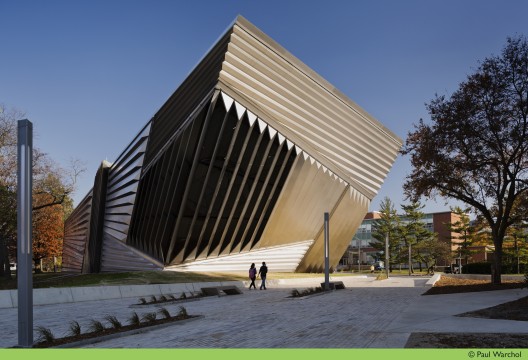
Following the same visual strategy of
transparency, the facades are translucent, allowing free and startling
overview to the surroundings through the woven strips or parted “gills”
made of punctured sheet. The picture of the day relied on the complexity
and diversity of the sunshine conditions and especially on the grazing
light of the morning and the sunset along the river. We have chosen a
white sheet with gold irisationsthat reflects the sky colors and the
surrounding environment. So the stadium becomes a huge chameleon and a
in a way, a solar clock.
In darkness the two possible states have
distinct images: a warm light distinguishes every night the rhythms of
structure and facades, and whenever the shows enflames the arena, this
grows into the largest lamp in the city and is dematerialized by
transparency. As architects we always wondered how to bring joy through
this construction. To those entering inside at a show and to those who
stays outside feeling its pulse, to those who are walking nearby and to
those who are watching from the distance